By Thomas Brauer
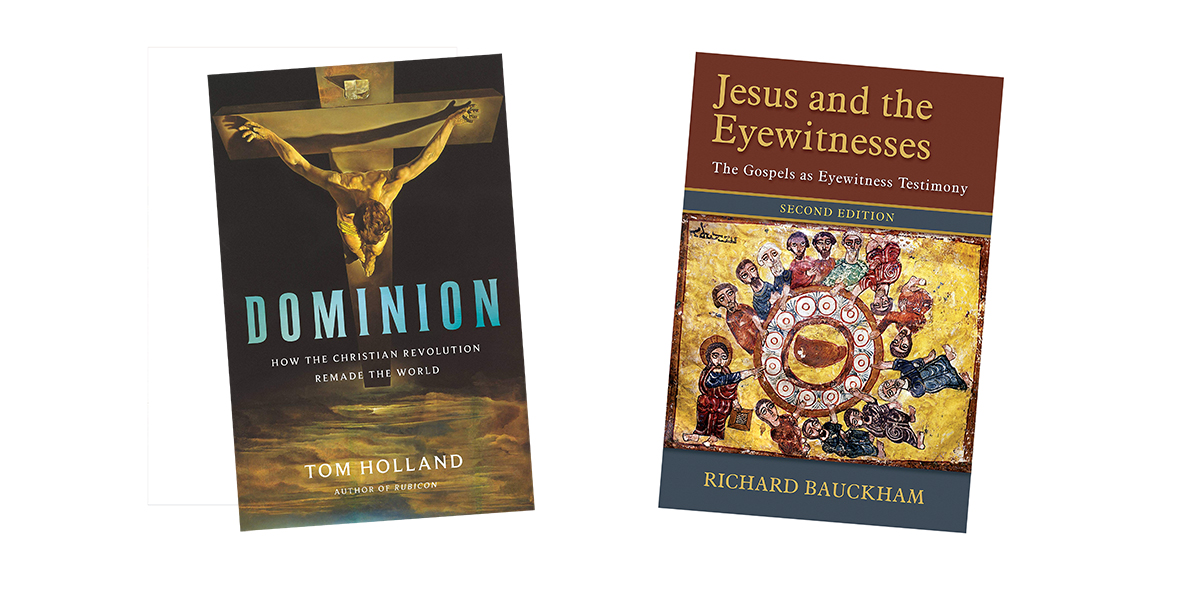
Tom Holland, Dominion: How the Christian Revolution Remade the World (Basic Books, NY, 2019; Trade paperback, 2021). 609 pages, incl. Index and endnotes. $29.99 CAD (Amazon). US edition. In the UK, published under the title: Dominion: The Making of the Western Mind.
Richard Bauckham, Jesus and the Eyewitnesses: The Gospels as Eyewitness Testimony, First Edition (William B. Eerdmans, Grand Rapids MI, 2006). 538 pages, incl. indexes. $94.98 CAD (Perfect Paperback; Amazon). 2nd edition, 2017 adds three chapters, new preface, and new bibliography. $71.97 CAD (Amazon).
Prologue: Why Read [These] Books Together?
This is not a normal review. This brief article is more about the benefit that might arise by reading these two books together. Too often we review books in isolation, speaking only of its gifts and deficits as if that book were being read in isolation from everything else in our libraries. Reading books intentionally together, in relationship, gives insights that might otherwise remain undiscovered. This is the first in an intended series of three short articles. The next installment will look at two other unconnected works and discuss how they too, when read together, add to the apologetic of the Resurrection: NT Wright’s The New Testament and the People of God (1992), and a new release from Gary Habermas, On the Resurrection Volume 1: Evidences (2024). The third essay will examine how all four works, read together, strengthen Christian confidence in the stories of the Resurrection as God’s transformative act in history for all people.
These two books could not be more different. Tom Holland’s Dominion is a popular work of historiography, rich in adventuresome stories, tracing the origins of contemporary liberal societies from pre-Christian Europe to today. The book reads quickly, despite its length. It’s a lot of fun. Richard Bauckham’s Jesus and the Eyewitnesses is an academic textbook for scholars and students of biblical criticism and the history and origins of the four Gospels as they journeyed from witnessed events, to remembered stories, to written traditions, to become transmitted canon. It is dense with footnotes and references with occasionally convoluted sentences (pot calling the kettle black, here) that make it challenging to read.
If these books are so different, and for such varied audiences, why read them together?
One reason is that reading these two books together gives us fresh support for the apologetics of the Gospel. Holland gives us an outline of what happened in Europe when the story of Jesus’ death and resurrection was believed – how cultures changed and old gods were overturned. Bauckham gives us an outline of why the story was believable – why the story they believed was trusted to the point of changing culture and giving up their gods. Reading these books together, we are left with a core apologetical insight: there is no other explanation for today’s culture except that the story of the gospels, and especially the resurrection, were founded on trustworthy eyewitness testimony. If the story were not trustworthy, why would the early Christians give up everything, even their lives (not a new question, but one foundational to the next)? If the story were not trustworthy, why would the Romans become ‘atheists’ and deny their gods? It the story were not trustworthy, why would societies founded on the privilege of the powerful and the subjection of the weak become societies that uphold the poor and weak as worthy of special care? By reading these two books together, the answer emerges. Argued with exceptional clarity and overwhelming evidence: the story of the resurrection of Jesus of Nazareth had its cultural, moral and societal impact (Holland) because the story is founded on accurate and trustworthy transmission from the eyewitnesses to the resurrection (Bauckham). And the proof that this hybrid of Holland’s thesis and Bauckham’s thesis is correct is our own society today.
Let’s start with Holland’s Dominion. This book describes the changes to society that followed the rise of Christianity and its movement into Europe to the present day. In answer to the question, “How was it that a cult inspired by the execution of an obscure criminal in a long-vanished empire came to exercise such a transformative and enduring influence on the world?” (p.12), Holland dedicates twenty-one chapters in three parts (“Antiquity,” “Christendom,” “Modernitas”) to explore the historical origins of the contemporary, scientific, liberal, Western-European society he was formed in. The result of that exploration was, for him, the conviction that such a society could not have existed in Europe were it not for the rise of Christianity and the foundational story of the Cross and Resurrection.
While Holland is not shy to point out where Christians have been on the wrong side of their own ethics and moral teachings (p. 286, p. 322, p. 542, etc.), his argument holds that the radical transformation of worldview from the assumed rightness of tyranny and power to the privileged care of the weak is inexplicable apart from the story and teachings of Jesus. Holland argues that the core experience of life in pre-Christian Asia and Europe was as Thucydides declared it in the 5th century B.C, “The strong do what they have the power to do, and the weak must suck it up” (p. 41, ref. Thucydides 5.81). He demonstrates the truth of this conviction through dramatic descriptions of torture and terror. From the horrendous, stench-laden display of mass crucifixions at the Sessorium on Rome’s Esquiline Hill (p. 1ff) to the similarly cruel practices of the Persians and the Greeks (pp. 22–23), to the violent, lascivious, and coercive gods of Greco-Roman devotion and the self-violence and mutilations performed in worship of them (pp. 30–36; Galatian veneration of Cybele, pp. 83, 137–8, 162), Holland demonstrates the ravaging attitude of power over weakness that was Europe’s norm.
Yet within a few centuries of the birth and resurrection of Jesus of Nazareth, a new way of seeing weakness as precious and power as servanthood arose wherever Christian evangelists, apologists, and missionaries travelled. For such a change to occur, for a culture to shift from a “might-makes-right” understanding of power, to a belief that humility is godly and good, requires an overwhelming shift in fundamental beliefs, philosophy and cosmology. For the old gods to be forsaken and replaced with the God that died on a cross and rose from the dead, people must have believed that the crucifixion and resurrection of Jesus of Nazareth actually occurred. To grant the courage to go against the gods, this story could not be the hysterical imaginings of a small group of grieving disciples. For those who first heard the stories of Jesus’ resurrection, the cruel and capricious gods needed to be put away because they understood and believed that the God of the humble had overwhelmed them by turning coercive power into weakness and weakness into glory in Jesus Christ.
For Holland, this historical narrative continues to the present day. He argues that contemporary, Western, liberal society is utterly founded on the values that arise when the weak are valued and the powers of empire are humbled. From this comes liberal democracy, and the scientific revolution, and all the movements that seek to liberate the weak from the powers of oppression – even the controversial ones like “woke-ism” or “#MeToo.” As points of contrast, Holland describes the Jacobins and their “enthusiasm…for the customs and manners that had existed prior to the triumph of Christianity” (p. 405), and demonstrates that it is this very triumph that Adolf Hitler rejected as he followed Friedrich Nietzsche in calling for a return to “traditional European” values and culture; desiring to rid Europe of the “weaknesses” caused by the foreign influence of Christianity (pp. 464–5). From Holland’s telling of 2000 years of European history, it is the teaching that power is found in weakness made evident upon the cross and triumphant in the resurrection that transforms Europe. Even though Christian individuals, nations and groups frequently operated in contradiction to the values of the Cross and so are condemned by today’s culture, it is by those very cruciform values that their actions are condemned.
The story told by Bauckham is not primarily historiographic. Rather, Bauckham lays out an argument for the trustworthiness of the whole of the Gospel narratives. Bauckham directly challenges many of the assumptions of contemporary Form Criticism: particularly, the portrayal of the Gospels as evolving traditions shaped primarily by the needs of distinct early Christian communities (see chapters 1 and 10). Rather than being formed to meet the needs of communities, the Gospels arise, Bauckham argues, from the testimony of named eyewitnesses who served to guarantee the accuracy of their remembered life events as these stories were handed on to others. In his usually dense style, Bauckham states, “Of curial importance for our whole argument in this book is the role of individual authors and tradents of Jesus traditions. We have suggested that the traditions were originated and formulated by named eyewitnesses, in whose name they were transmitted and who remained the living and active guarantors of the traditions” (p. 290).
Bauckham argues robustly from contemporary psychology and neuroscience for the trustworthiness of eye-witness testimony (ch. 13); he demonstrates from ethno-historians and others how such testimony becomes embedded in communities that value exact transmission (ch. 11); he lays out not only theoretical suggestions of how testimony could be handed on with accuracy (chapters 10–12), but outlines specific chains of custody for the Gospel traditions from historical sources (chapters 7–9, 14–17). By demonstrating the reliability of eyewitness memory, testimony and testimonial transmission, as well as extensive discussion from historical evidence outlining who the eyewitnesses of the gospels were, Bauckham builds a convincing case for the accuracy of the gospels for both the person of faith and for the historian of first-century Palestine. In summary, this book robustly demonstrates why the first converts to Christianity described by Holland trusted the Gospel stories they were told, and why these stories should continue to be trusted 2000 years later.
There is a “migrating anecdote,”certainly apocryphal, that tells of an early 20th-century English vicar and his encounter with a West End actor in London. The story goes that, after yet another Sunday service with too few congregants in the pews, the vicar was walking in the West End when he nearly bumped into the famous actor on his way to the theatre in advance of a matinée performance. In frustration, the vicar demanded to know, “Why is it that on Sunday morning my pews are empty, but on Sunday afternoon, your seats are full?” The actor paused, but only briefly, and replied, “Because, sir, I tell lies as if they were true, and you tell the truth as if it were a lie.” For nearly 2000 years the truth of the story was clear, and countless cultures were transformed by it. Today, the truth of the story is in doubt.
While many people of Christian faith look to society today with despair, seeing a falling away from faith as churches drain into the streets and fail to fill again, we remain with more that is hopeful than despairing. We remain with a story that is true and trustworthy. We remain with evidence of radical transformation that could only have happened because the story is true and trustworthy. We remain (if you will forgive the sermonic tone) with a God who really did show up, and who shows up still through the story, through the people who hold the story as joyful truth, and through the faith that transforms lives and cultures. From the arguments and evidence of Holland and Bauckham we can take hope that the trustworthy, eyewitness testimonies that convinced the Romans, the Greeks, the Gauls, the Britons, the Franks, the Germans (and so many more peoples) to give up their cruel and capricious gods and their cruel and capricious ways has the power to convince today’s cultures of new-atheism, scientism, neo-paganism, and strong-man politics to do the same. TAP
Thomas Brauer, with his family, has served the Church in one form or another in five countries and on four continents. He holds a PhD from the University of St. Andrews and the Institute for Theology, Imagination, and the Arts. Thomas has served in mission and/or church planting since 1996, and was ordained a priest in the Anglican Church of Canada in 2007. He is currently the incumbent of St. John the Evangelist Anglican Church, Smiths Falls, ON. Read more from Thomas at http://fiatpixel.com/
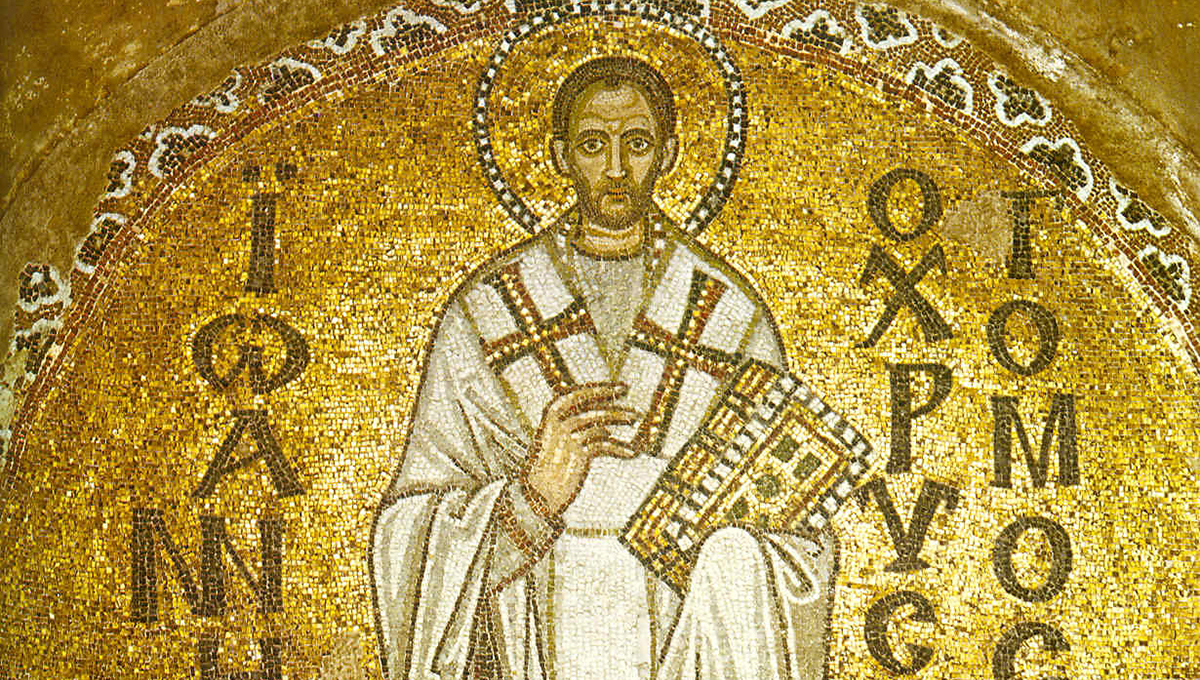
IN THE FOURTH century, in the region we now know as Turkey, there lived a pastor named John. Although his life was relatively short (he died at the age of 58) he has had an enormous impact on the Christian church. John was incredibly gifted, intense, and deeply serious about his faith. Not long after his conversion, he withdrew from society to live as a hermit for several years. He allegedly spent two full years doing nothing but memorizing the Bible while standing up. It was a rigorous discipline; he hardly slept, and his health was permanently damaged by the ordeal.
continue reading
ONCE when a friend and I were having coffee and chatting about hell, as friends do, and I grew increasingly squeamish at the topic, as one does, my friend surprised me by saying: “Why would someone bother sharing the gospel, if they weren’t thinking about saving someone from going to hell?”
continue reading
POOR Pierre Poilievre, leader of the Conservative Party of Canada. On the one hand, a part of his base thinks he is too mild. That he should be more outraged in response to a long list of grievances from the past years. On the other hand, media pundits (and, indeed, the polls) suggest he may be too pugnacious, too negative, to really appeal to the broader Canadian public. We’ll see if his new advisor, Steve Outhouse, can help him pivot to a new, more positive and visionary tone, to give him renewed hope of electoral success.
continue reading
AN Easter homily series on the spiritual senses got off to a strong start on April 12 at St. Thomas’ Anglican Church in Toronto.
ONCE when a friend and I were having coffee and chatting about hell, as friends do, and I grew increasingly squeamish at the topic, as one does, my friend surprised me by saying: “Why would someone bother sharing the gospel, if they weren’t thinking about saving someone from going to hell?”
How the writings of Tom Holland and Richard Bauckham support a resurrection faith today
Copyright © 2026 The Anglican Planet. All rights reserved